Amazing value for money! Satisfying results even with a Chinese effects pedal board
At the live house where I often play sessions, I don’t use effects pedals and mostly plug directly into the amp. I do this because it’s simple, lets me adjust the sound right at my feet, and I feel like it keeps the sound fresh.
However, when playing support gigs, there are times when I have no choice but to rely on effects pedals. I’ve been trying different approaches to handle those situations.
The first thing that comes to mind is a digital multi-effects unit. I mean, if one box could handle everything, it wouldn’t be heavy, and that would be awesome! So, I’ve tried the Zoom G3 and MS-50G before, but gave up on them. The one I have now is the G1X-Four, but it’s still gathering dust.
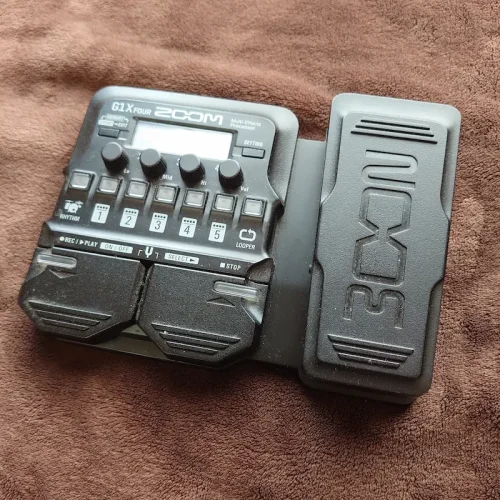
The reason it gets shelved is that even I, before my gigs or support slots, spend hours meticulously crafting my sound, thinking “Is this good enough?” before bringing it to the venue. However, the venue’s acoustics or amps sometimes make the sound unsatisfactory, or knobs I carefully set get knocked out of place… That’s when I really get stuck.
Since it’s not something I use regularly, I’d forgotten how to operate it and it took me a while to get to the settings… On top of that, even after the performance started, I kept pressing the wrong buttons, and I still wasn’t happy with the sound…
From that woeful experience, I came to the conclusion that unless I clearly separate each role, I simply can’t make proper use of them.
Effects Pedal Board Concept: A Commitment to Analog
Another thing I didn’t like about digital multi-track recording was how overly polished the sound felt. When I want to express rawness or power on the guitar, digital just sounds strangely too clean—like I’m listening to a CD.
It might be fine as part of an ensemble, but when I want to really go for it in a solo, I find it lacking. So when building my effects board, I decided to exclude digital pedals.
And when building an analog setup, I wanted everything to be true bypass—meaning the signal bypasses the internal circuitry when the effect is off. As someone who prefers plugging directly into the amp, it was something I felt strongly about.
Great value for money! I got all my gear from Chinese effects pedals!
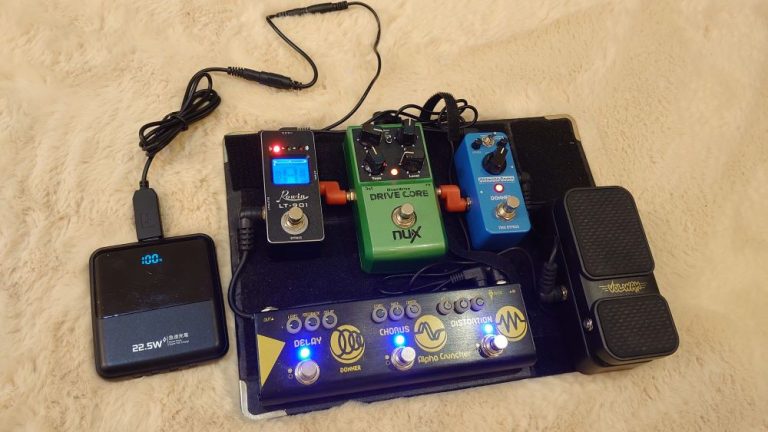
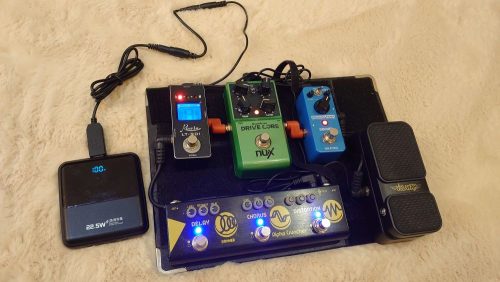
The first photo shows the current setup. I don’t remember the exact price of each item, but they were around ¥5,000 (approx. $35)each, so including the power supply for the mobile battery, it came to about ¥30,000(approx. $200) total. I got almost everything from Amazon and Soundhouse.
Furthermore, the size of the board is also important. This board is the kind used for circulating A4 paper, purchased at a dollar store, with Velcro attached to cover nearly its entire surface. This allowed me to keep it small enough to fit inside a guitar case.
The structure is as follows. Details for each section will be provided on separate pages!
- Sonicake / VolWah: Space-saving volume pedal + wah pedal
- Donner / Ultimate Comp: A compressor for when you want clean sound for backing tracks
- Nux / Drive Core: Boosts, drives, and even mixes!
- Rowin / Tuner: A tuner you’ll want for live shows
- Donner / Alpha Cruncher (Distortion): For deep distortion tones
- Donner / Alpha Cruncher (Chorus): Chorus effects
- Donner / Alpha Cruncher (Delay): Delay effects
Ultimately, it comes down to ease of use and whether it sounds good to your ears.
Actually, my wife has been in bands since high school. She still has all her old gear, so our house is full of vintage pedals like Maxon and Boss. We’ve got like three or four distortion pedals! We even have a Jim Dunlop Jimi Hendrix Wah pedal!
But since they were so old, I was a bit worried, and I wasn’t used to using them… so I ended up building the board entirely with Chinese-made effects pedals.
So, as a result, I believe I was able to build an effects board with the smallest possible footprint by combining pedals that I’m satisfied with. I think the key to this effects setup is the distortion provided by the Nux Drive Core and the Donner Alpha Cruncher.
I use it like this: I create crunch tones with the Drive core, build deep distortion with the Alpha Cruncher, and even use the Comp for whistling-like sustained distortion. That’s my basic tone-building approach, and then I add embellishments.
I think that ultimately, it’s only when you find something easy to use and feel satisfied with the sound it produces that you can play with confidence.
コメント