

I’ll tell you about the S.Yairi “YD-304” that the owner of my regular live house bought.
The owner always complains about being broke, but suddenly he’ll buy something nice. This guitar was just hanging on the wall one day out of nowhere. As someone who’s unbeatable at buying cheap stuff, I thought, “Whoa, it’s a Yairi!” and started to see him in a new light.
I remember this S.Yairi well from a book I bought in middle school evaluating domestic guitar makers. It was praised as absolutely top-tier, ranked right up there with Martin in that book, which made a deep impression on me.
S.Yairi was completely out of reach for me back then, so I don’t recall all the models they had. But this YD-304 model was apparently used by Yosui Inoue at the time and was the guitar every guitar kid dreamed of. I think it cost around 80,000 yen back then. Considering that was about a month’s starting salary back then, it would be a high-end guitar worth around 200,000 yen today.
As for the sound, it’s incredibly brilliant, with beautiful overtones. It feels like a different character compared to my other ridiculously powerful guitars. It has volume and a well-balanced tone. Undoubtedly a well-made dreadnought. It’s also very playable, like a Martin D-28 kind of guitar.
But! Thanks to its master’s careless nature, this particular guitar carries this bluesy aura, like a fallen king. The bridge has a mismatched endpin stuck in carelessly, the body is covered in scratches and looks like it’s been ignored. The finish is held together by some kind of ribbon-like strap… and the strings? Who knows when they were last changed. Yet, when you play it, it asserts its true power. It’s like a battle-scarred warrior, battered but formidable.
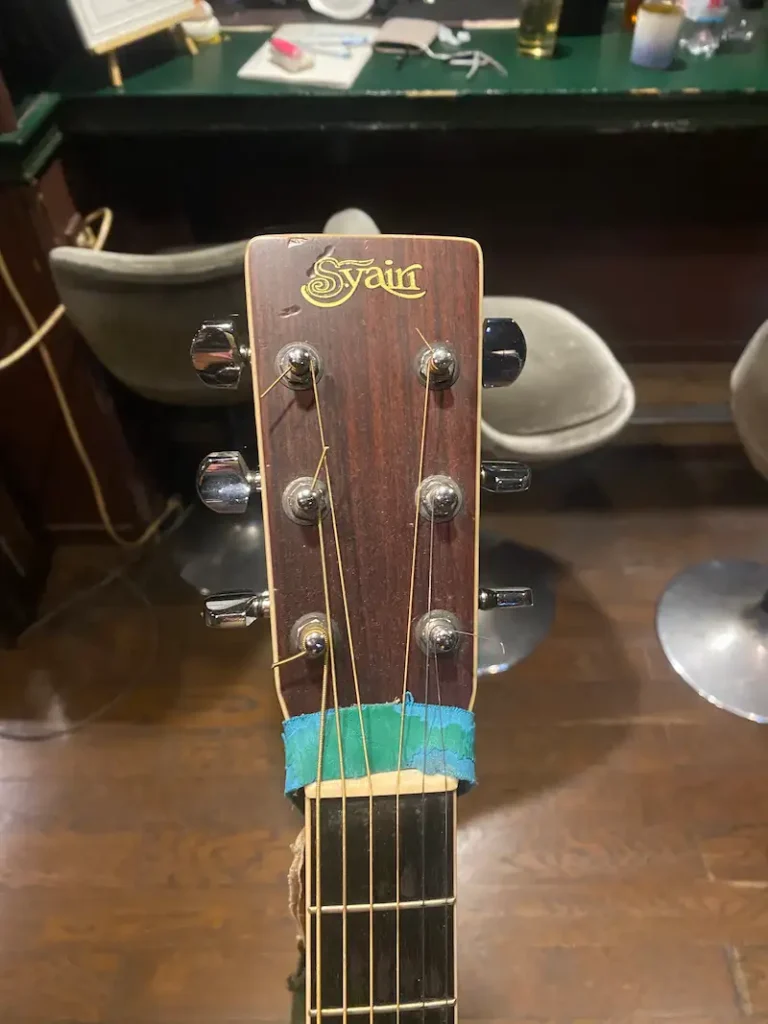
Well, I guess that’s just how the master is, but I do think he should pay a little more attention to it sometimes… Not that I’m one to talk, since I’ve had Elixir strings on my guitar for about two years straight at home. (laugh)
Incidentally, this guitar uses rare and expensive woods sparingly. The sides and back are Brazilian rosewood, and the top is solid spruce—truly befitting a high-end guitar of its era. You could say it’s a guitar that couldn’t be made today.
This guitar was around ¥50,000 at Hard-off, I think? The sides and back have that milky discoloration (apparently a common Yairi trait), and well, I suppose that’s about the going rate. But the wood is incredible, it’s completely dried out, it sounds great if you don’t mind the looks, and the wood itself is valuable… so it’s probably a good deal. That said, people who care about the wood probably care about the looks too.
By the way, as many of you probably know, besides S-Yairi, there’s also K-Yairi guitars. I looked into that a bit.
“S.Yairi” and “K.Yairi” have very similar names, making them easy to confuse, but actually, “they are completely separate brands from the founding to the present, despite the founders being relatives (brothers).”
I’ve organized their respective positions, histories, and modern differences in an easy-to-understand way.
1. S.Yairi
Legendary Japanese Vintage, Now Focused on Cost Performance
Founder: Sadao Yairi
History: Established in 1938. In the 1970s, it was favored by major artists like Yosui Inoue and became wildly popular, but went bankrupt in 1982.
Features (Vintage): Models from the 1970s, like the previously mentioned “YD-304,” boast exceptionally high quality and still command high prices on the used market today.
Present: The brand was revived in 2000 by Sadao’s son, Hiroshi. Currently owned by Kyōritsu Corporation, it primarily offers affordable, beginner-friendly models manufactured mainly in China.
2. K.Yairi
Handcrafted in Japan by master artisans, synonymous with a lifetime companion
Founder: Kazuo Yairi (nephew of Sadao Yairi)
History: Founded in 1935. Consistently handcrafted by a select team of artisans at our own factory in Kani City, Gifu Prefecture, to this day.
Features:Lifetime Warranty: Driven by the desire for customers to cherish their instruments for life, we offer a lifetime warranty (including paid repair support) on our products.
Playability: Features uniquely evolved designs, such as neck shapes that fit Japanese hands comfortably and slightly smaller body sizes.
Wood Selection: Only wood that undergoes our unique “seasoning” process—allowing the wood to rest—and achieves stable quality is used.
International Recognition: The brand “Alvarez Yairi” is highly regarded worldwide.
…And so, the cycle of prosperity and decline played out here too. Fifty years is undeniably a long time.

コメント