- The meaning of the term “Japan Vintage”
- Why Acoustic Guitars, Not Electric Guitars, Hold the Spirit of Aging Gracefully
- In the 70s, Furniture Makers Took on the Challenge of “Serious Guitar Making”
- The Magic of “50 Years” That Transcends Plywood and Laminated Wood Walls
- The Truth Proven by the Yamaki: “Even Cheap Stuff Can Be Awesome”
The meaning of the term “Japan Vintage”
Before I knew it, the term “Japan Vintage” had become commonplace, and old guitars started fetching high prices. For someone like me who lived through the era when these instruments were new on the market, it feels somewhat gratifying. Yet at the same time, I wonder about the practice of lumping everything together under the broad label of “Japan Vintage.”
Ultimately, what makes Japan Vintage so desirable? Digging deeper, it comes down to this: “Back then, the wood used was sourced from a global environment with far greater abundance than today, meaning much better wood was available.” “Japan rode the guitar boom wave, attracting highly skilled furniture makers and woodworkers to turn to guitar making.”
“Diligent Japanese craftsmen gradually grasped the instrument’s essential character and embodied it.”
And above all, “Half a century has transformed the wood, maturing it into truly remarkable instruments.”
That’s why I believe the term “Japan Vintage” truly applies only to acoustic guitars.
Why Acoustic Guitars, Not Electric Guitars, Hold the Spirit of Aging Gracefully
Regarding electric guitars, aging certainly affects the sound, including factors like wood drying. However, I believe that for electric guitars, factors such as what wood is used, its hardness, density, and weight, the condition and quality of the electrical assembly, the choice of metal parts, and the state of components like the bridge and nut have a greater impact than simply the dryness of the wood.
The quality of an electric guitar is largely determined by its fundamental construction. The degree of drying due to aging doesn’t have as significant an impact as it does on acoustic guitars. Indeed, back in the late 70s, I personally felt that the craftsmanship of electric guitars from the era known as Japan Vintage was superior to that of the original Fender and Gibson. So, while I wanted the originals because they looked cool, I didn’t feel there was a difference in their value as instruments. I suspect this was a common sentiment among us guitar kids back then.
So, moving forward, I’d like to focus the discussion on acoustic guitars and talk about Japan Vintage.
In the 70s, Furniture Makers Took on the Challenge of “Serious Guitar Making”
There was a time in Japan when everyone had a guitar. Every household had one or two, just like appliances!! (Maybe I’m exaggerating a bit.) I think it was during the 70s when folk songs were popular in Japan. Back then, Japanese furniture makers with their precise craftsmanship jumped on the bandwagon to make a profit… that was the backdrop of the era.
But what was truly amazing was the Japanese artisan spirit. They took apart extremely expensive Martin guitars to study their construction, researched drying methods to prevent warping… They tackled guitar-making with a seriousness that felt quintessentially Japanese. The result? Guitars like the Morris from Terada Gakki and Yamaki guitars that I love today—instruments that, after half a century, have transformed into incredible pieces. That’s the true essence of Japan Vintage.
The Magic of “50 Years” That Transcends Plywood and Laminated Wood Walls
Even back then, there were companies and models that aimed for the high-end market. People wanted S-Yairi guitars or Morris W-80s—hard-to-find domestic luxury items were available even then, and I’m sure many people desired them. And if those guitars still existed today, most of them would undoubtedly be top-tier vintage instruments. They were unquestionably high-end products, crafted with the finest materials and techniques available at the time.
But my recommendation, or rather my interpretation, is a bit different. Expensive instruments being good is a given. But!!! Many old Japanese guitars have transformed into incredible instruments!! Everyone!
The high-end models of that era undoubtedly took time to dry the wood properly. But at most, it was a few years. Since then, many years have passed, making those few years now practically negligible. And what I’ve personally come to realize is that individual variations between instruments make a bigger difference than the difference in the wood itself.
And while it’s common knowledge in the guitar world that high-end guitars have always used solid wood, while cheaper models use laminated wood, to my not-so-great ears, I can barely tell the difference. Right now, all the guitars I love are cheap ones with laminated tops.
The Truth Proven by the Yamaki: “Even Cheap Stuff Can Be Awesome”
I like guitars with loud volume and responsive action. On the other hand, guitars that aren’t loud but have a beautiful tone… I don’t know any, I don’t understand them. Because I think if the volume is low, that just means the range for expressing nuance becomes narrower. I consider a guitar that responds by resonating its entire body when you really dig into the low strings to be a good instrument.
I totally get that feeling of wanting to buy a guitar that was high-end and out of reach back in the ’70s! It’s a perfectly legitimate desire, and I understand it completely. Unfortunately, I don’t have much money, so I can’t afford those luxury items. But as a player, I can say this with certainty: even among the cheap stuff, there are some seriously amazing guitars out there… that’s what Japan Vintage is all about.
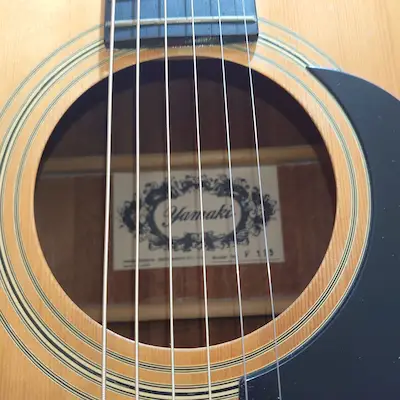
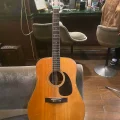
Take this Yamaki guitar I got recently, for example. I got it on Yahoo Auctions for ¥8,000 (shipping included), and when it arrived, it was an amazing-sounding guitar.
The seller’s comment said, “This is my dad’s old guitar. I don’t know much about it, so I’m selling it cheap.” But when it arrived, it was an incredible instrument. I found another one of those rare gems that makes your whole body vibrate with its sound. Seriously, I’m thrilled!
Don’t you think these crazy old cheap Japanese guitars are seriously fascinating?
コメント