Yamaki: The Story of How I Got the F-115
Actually, I’ve been relying heavily on AI to write this blog. It instantly compiles and tells me things like the historical context of guitar companies or product information—stuff that would take hours to research myself. Wow, what an amazing era we live in.
Through consulting with AI on various points, my preferences for instruments gradually became clearer. My tastes are roughly like this:
*I prefer guitars with a loud sound.
*I love guitars that make my whole body vibrate.
*Four guitars that have truly impressed me so far, three had mahogany bodies.
*Solid top matters; laminate doesn’t. It was about half and half.
*Every guitar I love is very old.
And the AI suggested guitars matching my preferences: loud, forward-sounding guitars, preferably with mahogany bodies, and recommended the dreadnought type. For me, the only Dreadnought-sized guitar that ever felt right was an old Gibson J-45.
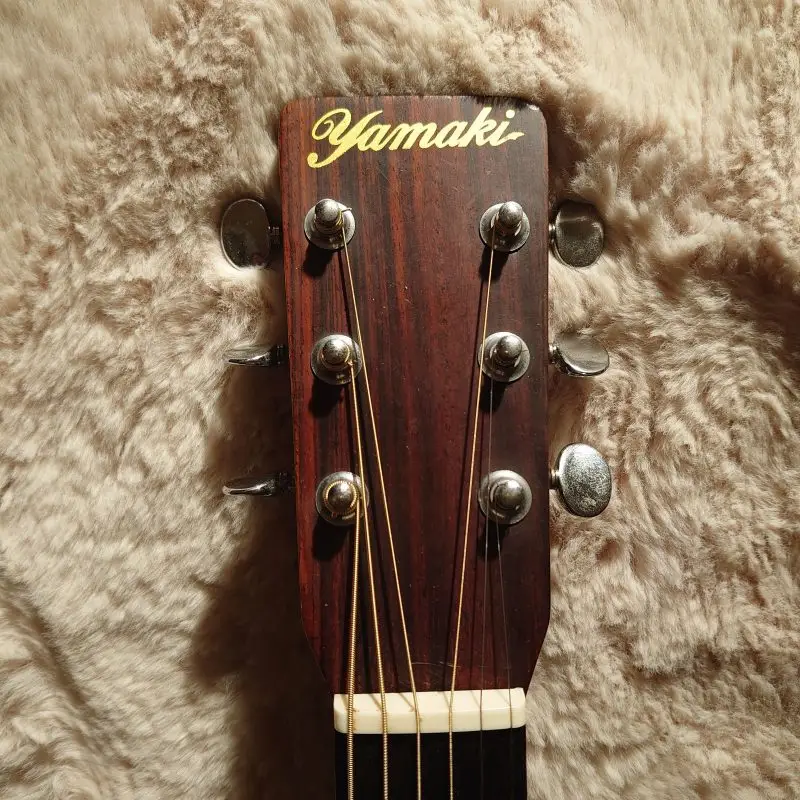
Then one day, while asking the AI for recommended Japanese vintage guitars, this Dreadnought from a company called Yamaki suddenly popped up. I’d heard the name before, but what kind of instrument is it? What kind of company is this?
A company called Yamaki
What kind of company was Yamaki?
A Collective of Craftsmen: Founded in the late 1960s by the Teradaira brothers after they left Daion Musical Instruments, it was a legendary manufacturer originating from Nagano Prefecture.
An Obsession with Resonance: Known for its artisan-like approach to manufacturing, it pursued “how to make it resonate” over efficiency or decoration, sparing no effort.
OEM Giant: Beyond its own brands, it possessed advanced technical capabilities that supported manufacturing for renowned international brands like “Washburn.”
Entering the Global Market as “Daion”: By the late 1970s, they broke away from Martin copies and entered the global market under their own brand, “Daion.” They crafted highly original and modern guitars, featuring brass nuts and saddles, and even drilling holes in the headstock.
Highly Regarded Overseas: These guitars, exported to Canada and the United States, are still beloved by passionate collectors in the international vintage market under the “Daion” name.
Too Labor-Intensive to Be Profitable: Yamaki ceased production of its own brand in the mid-1980s. The reason cited was not that they “didn’t sell,” but rather that they became too labor-intensive to be profitable.
Yamaki F-115 was a smash hit
Following that AI recommendation, I searched for Yamaki guitars on Yahoo!Japan Auctions. You hardly ever see these guitars in music shops, but there are quite a few on Yahoo Auctions. And as usual, the premium models with the vertical logo are incredibly expensive. Some exceed ¥100,000, which is probably more than they cost new back in the day.
However, the more affordable models are cheap. Since I’m looking for a mahogany-bodied dreadnought type, only the more affordable models fit the bill.
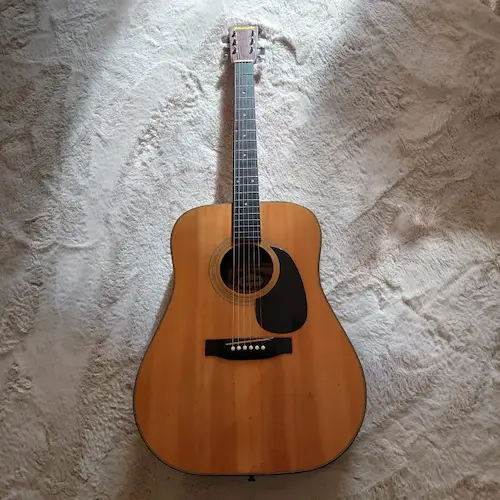
And then I found it! The Yamaki F-115 pictured! This wasn’t an auction; it was a fixed price listing for (including postage). Being perpetually broke, I gave it a night’s cooling-off period. After all, I already own quite a few guitars.
Then, the next day, I checked again and what do you know? It had dropped to ¥8,000 (including postage)! I took this as a sign from above and clicked… done.
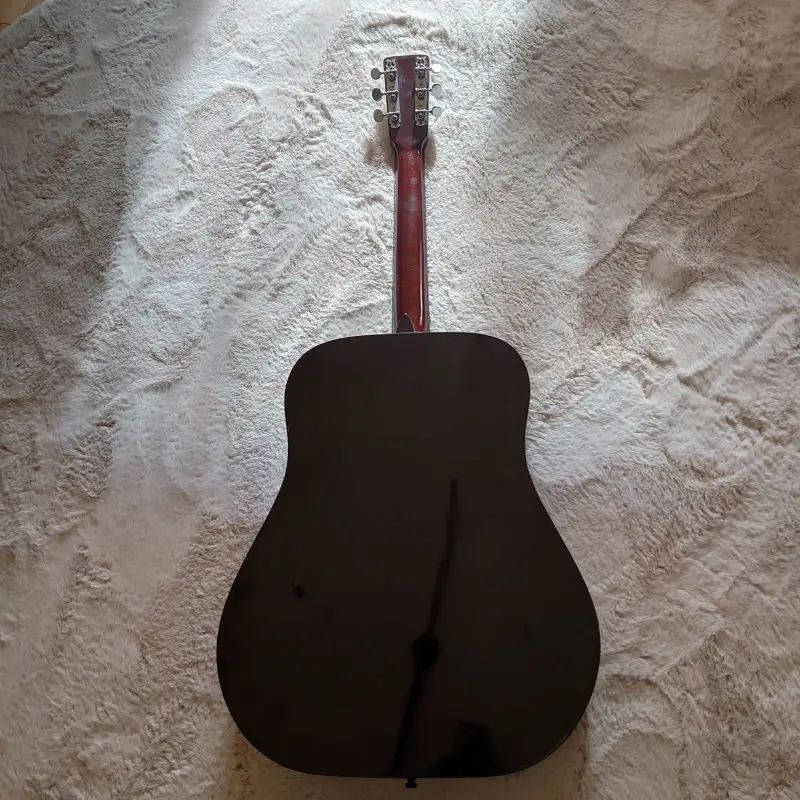
According to the seller, this guitar was “my father’s old guitar. I don’t know much about it, so I’m selling it cheap.” There were only about three photos, no side view to check the neck condition, and the strings were pitch black. No rear view either, so I couldn’t tell if the sides and back were mahogany. However, the top showed a nice wood grain and didn’t look overly sun-faded.
And a few days later, it arrived! Packed only in bubble wrap! I hurriedly opened it to find a dust-covered guitar. I cleaned it thoroughly, replaced the strings with my YAMAHA coated ones… and thus, this YAMAKI F-115 was reborn after half a century!! Incidentally, judging by the cursive logo and model number, this guitar was likely manufactured around 1970 to 1972.
Even during tuning, this guitar resonates deeply with the sheer joy of producing sound after so long. And the moment I strummed a chord, I too was overcome with bliss. The separation of notes is superb, and the tone responds magnificently to the dynamics of your picking. It plays softly with delicate nuance, yet responds to forceful picking with a bold, powerful sound.
It was truly a winning specimen. Compared to my Morris F-18 (which I consider one of the finest Japanese vintage guitars I own), the F-18 gives the impression of sound arriving in a single, cohesive mass, pushing forward forcefully. This YAMAKI F115, on the other hand, allows the sound of each individual string to be clearly heard, creating an impression of rich resonance.
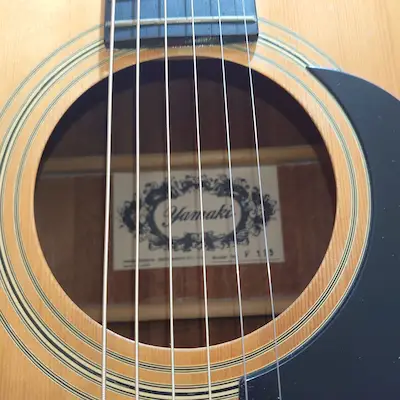
Incidentally, I examined the soundhole closely to check whether the top spruce was solid or laminated (though I assumed laminated given the price point), and discovered the wood around the soundhole had been carved incredibly thin. This seems difficult to achieve by machine, making me sense a level of craftsmanship bordering on obsession from the YAMAKI company.
When I showed the guitar to my wife (who plays guitar, bass, piano, and has perfect pitch), she initially showed little interest, remarking, “You bought another one? You’ve got plenty already.” However, after trying it herself, she immediately recognised this particular instrument’s quality, saying, “The resonance is really lovely.”
It was truly the perfect one for me. And to add to that, despite being over 50 years old, it was a very beautiful instrument. Its unadorned, dignified presence, reminiscent of a Martin D-18, made me think “That’s cool,” and I was also surprised that the pegs could be used as they were. They were triple pegs, like those found on classical guitars, which are rarely seen nowadays, and I imagine they were a very high-quality product at the time.
Japan Vintage has many gems
So, on that note, this time around, thanks to my AI assistant’s recommendation, I ended up making a rather impulsive purchase of a guitar that turned out to be an absolute gem. Speaking from my own experience, I’d say guitars from this era tend to be quite reliable. I genuinely believe this guitar is better than most brand-new Martin D-18s, and the two Morris guitars I own, while each having their own distinct character, are also excellent instruments.
All these guitars fall within the beginner to entry-level price bracket, yet their tone is first-rate. I hear Japanese vintage guitars are gaining attention overseas lately, and it’s no wonder why. I really hope many people, especially those just starting to play, will give these older Japanese guitars a try.
コメント