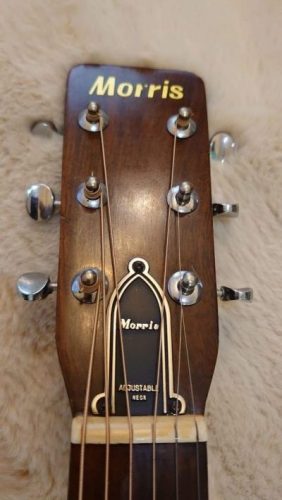
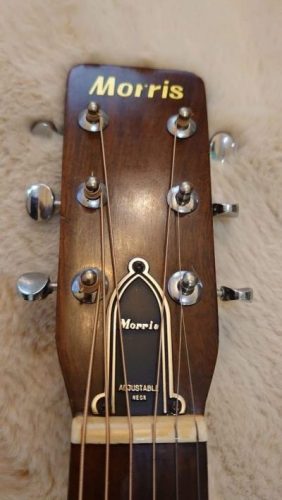
The only acoustic guitar I have right now is a Morris.
The acoustic guitars I’ve owned in the past include six Morris, three Yamaha, one Ovation, one Thumb… and the rest I don’t really remember. Right now, I only have two Morris guitars from Terada Gakki.
Why did it come to this? Because the only overwhelmingly “great finds” I’ve ever experienced were these two Morris guitars from Terada Gakki. One was a former “Bokko Guitar” F-12 (I think?). I believe it had a mahogany back (my memory’s fuzzy), but I was amazed by its incredible volume. Sadly, I don’t have it anymore.
The second is the F-18 (with a finished top) I own now. It arrived at my place looking a bit rough with some stains, but its performance was every bit as good as the now-gone F-12. After refinishing the top, I’m pretty proud to say it turned into a really cool-looking guitar. And both are 000 types? What used to be called folk guitar types.
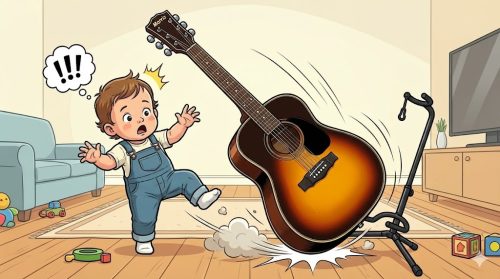
This is surely just a matter of my luck. The reason is that I’ve never had any luck with dreadnought-type guitars. Ah, but I just remembered—actually, I recall the Korean-made Morris MG-301 had a pretty good sound. Unfortunately, when my toddler son knocked it over on a whim, the neck was destroyed…
The Mystery of Morris Guitars
As many of you may know, the Morris brand actually employed a rather complex manufacturing system. It appears four companies participated in production: Moridaira Gakki, Terada Gakki, Iida Gakki, and Yairi Gakki. Iida Gakki seemed to handle the more affordable models, Yairi Gakki the high-end ones, while Terada and Moridaira likely focused on the most in-demand models.
Moreover, this wasn’t a strictly divided labor system. It seems they operated more like, “Oh, we’re running low on F-12s, so Terada, could you handle that?” Consequently, the stickers visible inside the soundhole lack uniformity—sometimes round, sometimes square, and sometimes lacking any manufacturer indication at all.
Consequently, it seems common to identify the manufacturer based on the responsible person’s signature displayed on most stickers. Actually, I recall that all the guitars I own that I consider good were made by Mr. F. Yamada, so I basically only look for guitars made by Mr. Yamada at Terada Gakki. Incidentally, here’s a list of known signatures (apologies for omitting honorifics):
*Terada Gakki: Yamada, Sasaki, Yamazaki, Iwai
*Iida Gakki: Sugiyama, Nagao, Tamakoshi, Karasawa
*Moridaira Gakki: T. Moridaira, S. Hokari, S. Harada
Incidentally, I was curious about what became of these manufacturing companies, so I looked into it. Yairi Gakki, however, has always been S. Yairi, focusing solely on high-end instruments and still going strong. So I’ll exclude them from here on.
The Aftermath of Maurice Guitar Manufacturing Company
Moridaira Musical Instruments (still going strong today)
創のFounded by Toshio Morihira, this company has established a solid position as a major trading company and manufacturer in Japan’s musical instrument industry.
Current Morris Guitars:
Premium Handmade Line: Handcrafted by artisans at the company’s own factory in Matsumoto City, Nagano Prefecture. The S Series, designed for solo guitarists, is particularly renowned for its exceptional quality.
Performers Edition (Mass-Market Line): Production of the low-to-mid-priced models, once made by Iida Gakki, has now shifted to overseas factories in countries like China.
The Trading Company Side: In fact, Moridaira Gakki isn’t just a guitar maker; it’s also an incredibly powerful company as an import distributor for overseas brands.
HOHNER: Harmonica
Jim Dunlop: Picks and effects pedals
Moog: Synthesizers
Iida Musical Instrument Manufacturing (Lost in the Mists of Time)
Once the manufacturing backbone that churned out tens of thousands, even hundreds of thousands, of guitars like the Morris F-10, F-12, and W-20—the first guitars many young Japanese people ever owned—it no longer manufactures guitars.
Reasons for Decline: The “strong yen” and “soaring labor costs” starting in the late 1980s hit hard. It became an era where “manufacturing guitars priced at ¥10,000 to ¥20,000 domestically in Japan was no longer profitable.” Consequently, Morris (Moridaira) was also forced to gradually shift its production bases to Korea (Peerless, etc.) and China.
Afterwards: Iida Gakki (Aichi Prefecture) withdrew from guitar manufacturing as its role ended with the overseas relocation of Morris’s production line. The once abundant “Iida-made Morris” guitars are now reevaluated in the Japan vintage market as “the crystallization of Japanese mass production technology, never to be made again.”
The Aftermath of Terada Musical Instruments (Actually a Winner)
As for the instruments, they’re still going strong today.
Current Terada Gakki: While sticking to a style of exclusively manufacturing OEM (other companies’ brands) without its own brand, its technical prowess gained worldwide recognition.
Gretsch: Their premium line is made by Terada.
Epiphone: They produced Japan-exclusive premium models (Elitist).
D’Angelico: They handle top-tier solid-body guitars and more.
To summarize:
Moridaira: Achieved great success as a trading company & premium manufacturer.
Iida Gakki: Swept away by the tide of the times (yen appreciation), it quietly closed its doors after fulfilling its role.
Terada Gakki: Survived as the “world’s high-end OEM factory” through advanced technical expertise.
…That’s the story. Within its long history, Morris Guitars experienced a unique rise and fall.

コメント