Options for guitar beginners to avoid giving up. Why Japan Vintage is the ultimate partner.
- Before you give up, pick up the “right answer” that’s been refined over 40 years.
- Why does practice for beginners become an ordeal?
- Three Decisive Reasons Why “Japan Vintage” Is Especially Recommended for Beginners
- To those of you who feel uneasy about buying a used guitar because it’s secondhand
- Conclusion: For your very first one, choose the real thing.
Before you give up, pick up the “right answer” that’s been refined over 40 years.
It’s said that about 90% of people who start playing guitar give up within a year. I don’t think the reason is often a lack of talent on your part.
Could the reason be that you chose a guitar that’s hard to play and sounds bad?
If you wish to “keep playing for a long time” or “get closer to that sound you admire,” before buying a brand-new beginner set, learn about the option called “Japan Vintage (JV)”—guitars made in Japan 40 years ago.
Why does practice for beginners become an ordeal?
The entry-level models costing tens of thousands of yen that many beginners first pick up. Unfortunately, many of these are barely adjusted for each individual instrument due to cost-cutting, leading to problems like the following:
String height is too high, hurting your fingers: A 1mm difference can make playing an F chord feel impossible. Beginner guitars aren’t adjusted because of their price point.
The sound is muddy and uninspiring: Even while practicing, you feel “something’s off,” and your motivation fades.
The neck warps quickly: The wood is young and vulnerable to humidity, causing the neck to shift significantly with seasonal temperature and humidity changes. Before you know it, the guitar often becomes awkward to play. In severe cases, it can even become unusable as an instrument.
Solving these problems and guiding you to become someone who can play are the Japanese-made guitars crafted in the 1970s and 80s.
Three Decisive Reasons Why “Japan Vintage” Is Especially Recommended for Beginners
① The overwhelming stability born from wood dried over 40 years
Japan Vintage guitars were manufactured over 40 years ago. When we talk about high-quality “Japan Vintage,” brands like Greco, Tokai, Fernandes, Yamaha, and Ibanez are essential. Because these manufacturers produced amazing instruments in the 1970s and 80s, the moisture within the wood has completely evaporated. It has reached a “stable state” where the wood will no longer warp.
Resistant to Neck Warping: Maintains optimal playability at all times.
Stable Tuning: No more wasting time tuning during every practice session.
② The Golden Age of Craftsmanship That Astonished the World
In the 1980s, Japanese guitar craftsmen boasted world-class skills. Even mid-range models (then priced between ¥50,000 and ¥80,000) featured meticulous construction comparable to today’s ¥200,000 to ¥300,000 class.
Neck that feels like it’s sucking you in: Often designed for Japanese hands, making chord voicing significantly easier.
Authentic tone: The sound produced by carefully selected woods possesses a depth that even beginners can recognize as “great tone!”
③ Asset Value: If you get tired of it, you can sell it for the price you paid.
A brand-new beginner guitar will fetch next to nothing (a few hundred to a few thousand yen) at a used store. However, Japan Vintage guitars, with collectors worldwide, retain their value remarkably well.
In fact, they may even increase in value going forward.
“Essentially, you’re borrowing a top-tier guitar for free (or even making a profit).”
When you think about it that way, there’s no smarter purchase.
To those of you who feel uneasy about buying a used guitar because it’s secondhand
Certainly, some express concerns about maintenance. However, the JVs currently on the market are instruments that have weathered 40 years of rough seas. Truly flawed instruments have likely already disappeared from this world.
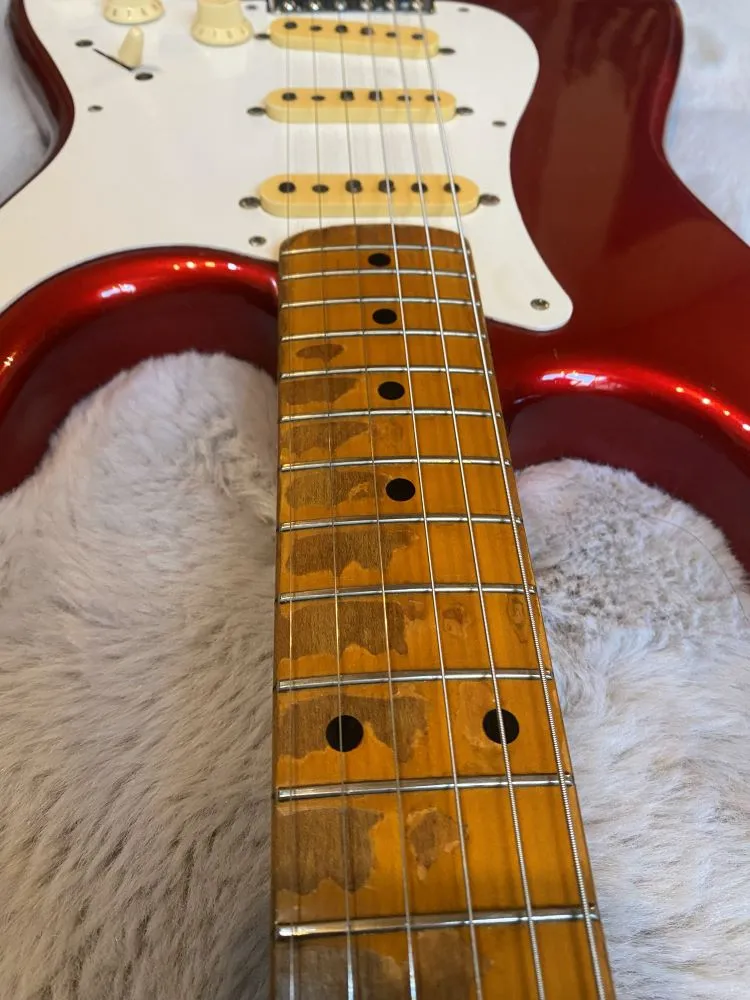
That one instrument before you now, looking a bit worn, is undeniable proof that it has been loved and played by someone for 40 years.。
Conclusion: For your very first one, choose the real thing.
A guitar is a tool for making music. But it’s also a vital partner in nurturing your artistic sensibility. Especially for beginners, I urge you not to settle for “cheap is fine,” but to choose “a genuine instrument that will help you improve.”
The aged tone of a Japan Vintage guitar, the feel that fits your hands perfectly. The moment you hold it, your guitar life should shift from “obligatory practice” to “moments of pure bliss.”
コメント