
Welcome to my blog, where I occasionally share stories about Japan’s vintage guitars and other treasures waiting to be discovered,
alongside ideas for enjoying music without spending a fortune!

The guitar boom half a century ago
Did you know there was a guitar boom in Japan? Though half a century has now passed, there was a folk guitar boom from the 1960s to around 1970.
It was an era when everyone picked up a guitar at least once. And only those who could master the “F” chord progressed further – that remains true today, but I imagine the sheer number of people attempting it back then was staggering.
What is Japan Vintage?
Back then, the dollar was ridiculously strong (around 280-300 yen per dollar around 1975, with starting salaries around 90,000 yen), so American guitars like Martin, Gibson, and Guild cost around 200,000 to 300,000 yen – utterly out of reach. Responding to the demands of the era, factories with woodworking skills, such as furniture makers, stepped up.
When crafting instruments like guitars, proper wood drying and precision machining are essential. Furniture makers excelled at meeting these demands, leading them to begin producing Japanese guitars. Truly, the Japanese!
Today, these guitars are celebrated as “Japan Vintage”, attracting attention not only domestically but internationally.
In this blog, the term “Japan Vintage” refers not to high-end guitars, but rather to acoustic guitars that have developed a beautiful tone through ageing, or electric guitars still in active use today.
My Encounter with Japan Vintage
I started playing guitar in middle school. Following the typical path back then, I began with folk music and then drifted into rock, fusion, and other genres.
The first guitar I got was a shady folk guitar I bought at a pawn shop during middle school. I had no idea what brand it was. It didn’t have a truss rod, the neck was warped, and the string height at the 12th fret was probably around 1 cm.
It was a pretty wretched guitar, but I was just a middle schooler. With foolish passion, I somehow managed to play open chords, eventually learned to fret an F chord, and joined the ranks of the “guitar kids” everywhere.
Later, as a high school entrance gift, I got a Morris W-40 guitar. It was very easy to play, and while it looked nice, looking back now, it felt like an instrument without any real standout features.
Then, one day in high school when I was feeling pretty cocky, I borrowed a guitar from a younger girl in our folk song club. Getting carried away, I started jumping around and dancing, and before I knew it, I’d dented the side of her guitar. It was a Morris F-12 (or something like that).
When I returned it to her, I later heard she cried after seeing the damage I’d caused. Panicked, but lacking the money to pay for it, I convinced her to accept my W-40 in exchange.
That Morris F-12 was subsequently dubbed the “Bokko Guitar” (probably meaning something like a wooden stick) by everyone. It became the designated accompaniment instrument for parties and was gradually forgotten.
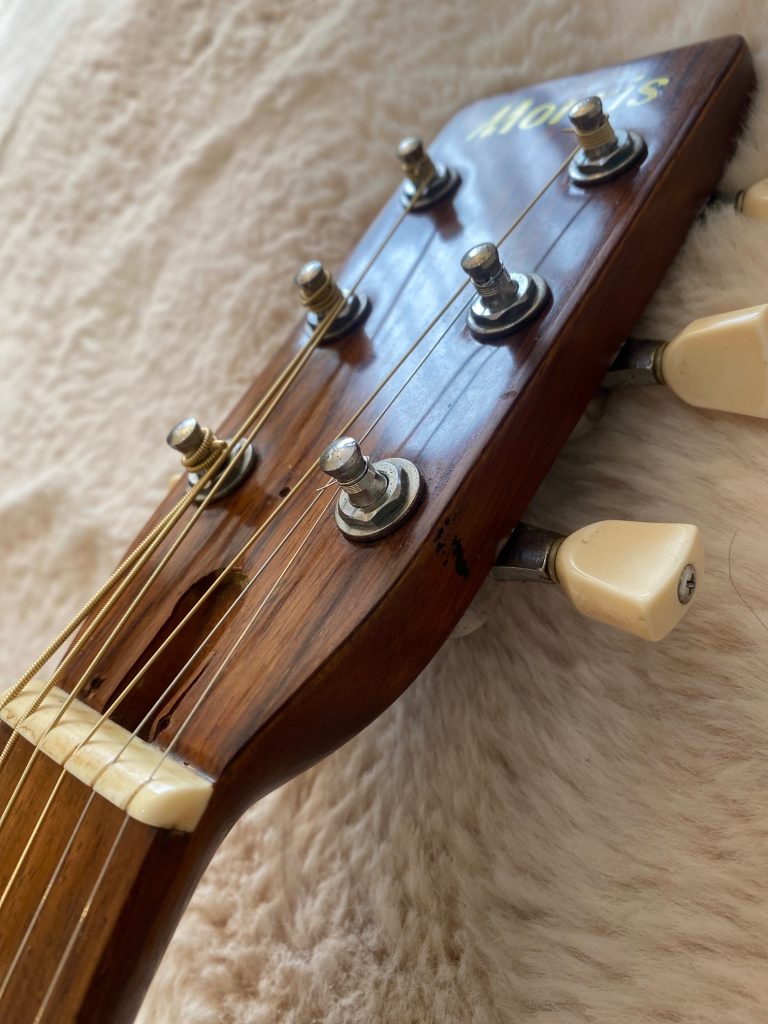
Then, without touching the guitar much, about 20 years passed. When I had become a mid-level company employee, I reunited with that beat-up guitar at a friend’s house. It was in a pitiful state, with only about three strings left. But when I plucked them, even though they were completely rotten, I thought, “This sounds weirdly loud.”
I took it home and replaced the strings. I was shocked by the incredible, explosive sound. The long years must have dried out the wood. Somehow, that beat-up guitar had transformed into a magnificent swan (though it still looked the same, of course).
That was my encounter with a Japan Vintage Guitar (Hmm, calling a cheap guitar vintage is weird, but since there’s no better name for it, whatever).
I replaced the tuners, straightened the warped neck as much as possible, leveled the frets, and carefully shaved down the nut and bridge to get it into good shape. Most of it was my first time doing these tasks, but since it was cheap to begin with, I could just dive right in. The result? The beat-up guitar transformed into an absolutely fantastic instrument.
That guitar never made it back to me due to the mess of personal circumstances (divorce, actually). That frustration is what started my quest for my own treasured guitar.
Enjoying guitar life without spending a lot of money
I’ve been through company bankruptcies, divorce, and other hardships, so financially, things are far from easy. Still, I jam at live houses and enjoy my musical life to the fullest. On this blog, I’ll share the methods I use to enjoy music without spending a fortune, using affordable yet quality gear like Japan Vintage guitars.
コメント